
How it works
Each Champion works at their own level. On screen, answers are checked at once, and you see how it went.
Bands, not grades
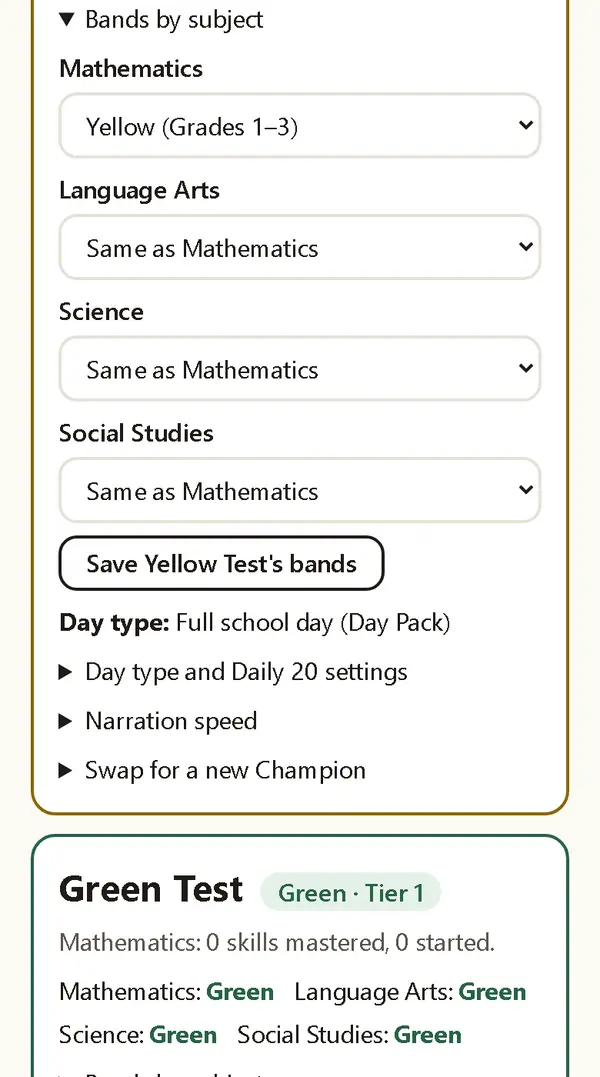
A Champion works at a band, not a grade: Purple, Yellow, Green, Blue, Red and Silver, with tiers inside each band. A band can be set per subject, so a Champion can be Yellow in Mathematics and Green in Language Arts.
Each band is about the same work as these grades: Purple ages 4–5 · Yellow Grades 1–3 (ages 6–8) · Green Grades 4–6 (ages 9–11) · Blue Grades 7–9 (ages 12–14) · Red Grades 10–12 (ages 15–17) · Silver the first year of college or university (ages 18+).
Daily 20 and the Day Pack
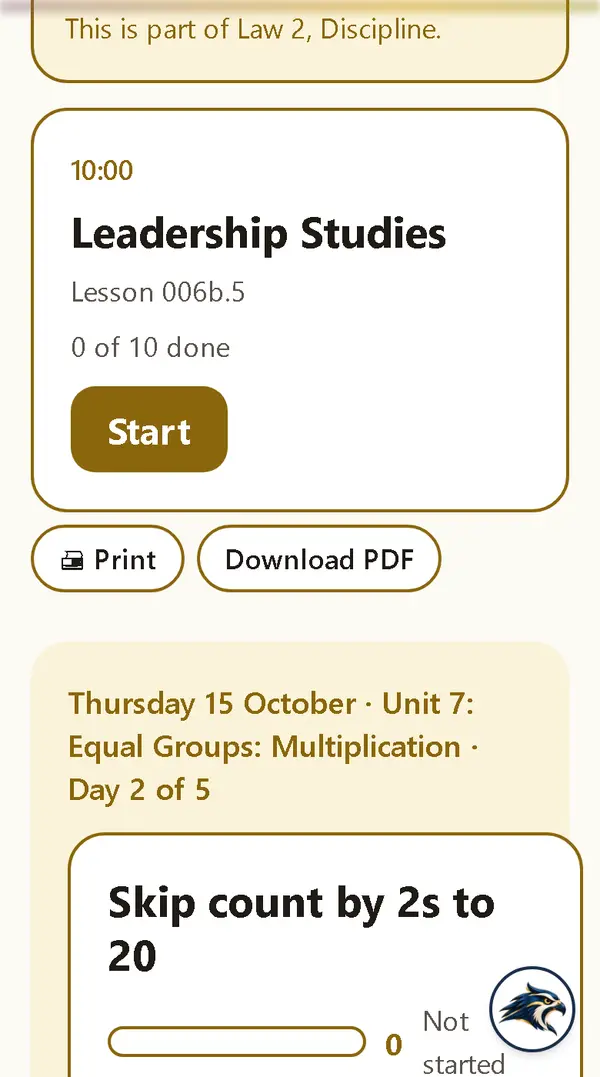
The Day Pack is a full school day: each subject's lesson for the day, in order, for families who home-educate.
Daily 20 is about twenty minutes after school: a warm-up drill, a short practice set and a story to read. At Purple it is about ten minutes, with a grown-up.
You choose one for each Champion. Daily 20 for school families
Chess, live now: a ladder of puzzles at each Champion's band, easiest first, and full games against ScholarHawk at three levels, on the Drills page.
Practice, checked at once
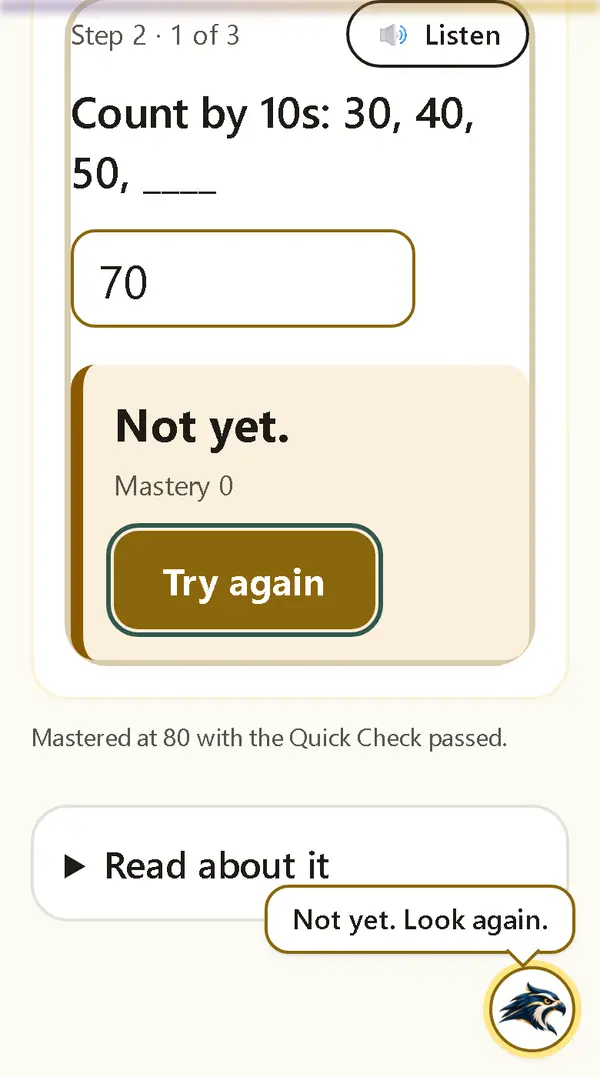
On screen, answers are checked as soon as they are given, and questions missed come back on a later day until they stick. A wrong answer gets “Not yet”, never a red mark: with a hint and another try, and a Champion can skip for now; after the last try the answer is shown, worked out, and the question comes back another day as a new one.
Each skill has a mastery score from 0 to 100.
Hawk Talk, the AI tutor: hints, never answers
Ask out loud. Get the next good question.
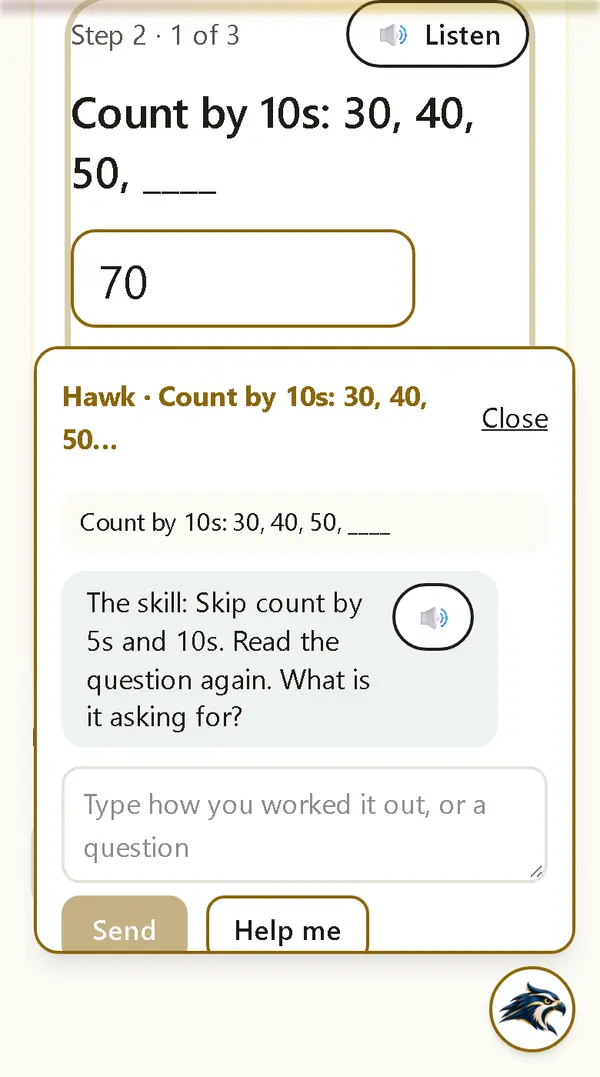
The Hawk is ScholarHawk's AI tutor. On a practice question it gives one hint at a time and asks the next good question. It never gives the answer to a practice, Quick Check or test question, and it is off on Quick Checks and tests.
From Yellow up, a Champion can type a question to the Hawk; at Purple, only with a parent. It talks only about the lesson in front of them. To reply to what a Champion types, it uses an AI provider, and only after a parent agrees.
Talking out loud. Champions at every band can talk to the Hawk instead of typing, once a parent switches it on, and hear it answer. Each band has its own daily limit (Purple 10 minutes, Yellow 15, Green and up 20), and after 10 minutes of talking there is a 2-minute stretch break. No recording of a Champion's voice is kept.
Children under 13 use the Hawk only with a parent's consent. Parents see every exchange in the parent view, typed or spoken, and can turn the Hawk, or talking, off at any time.
- Talk out loudChampions speak to the Hawk and hear it answer, with a daily limit and a stretch break.
- Read to meEvery lesson's reading can be read aloud, with the words lit up for young readers.
- Every band, Purple to SilverFrom Purple (with a grown-up beside them) to Silver, each at its own level.
- Parents see every wordRead every exchange, and switch the Hawk, or talking, off anytime.
- It asks, it doesn't tell.The Hawk gives one hint at a time, never the answer. You can read every word it says to your child, and under-13s use it only with your consent.
- Only the lessonNo chat with other people, no feeds, no ads.
Read to me, word by word
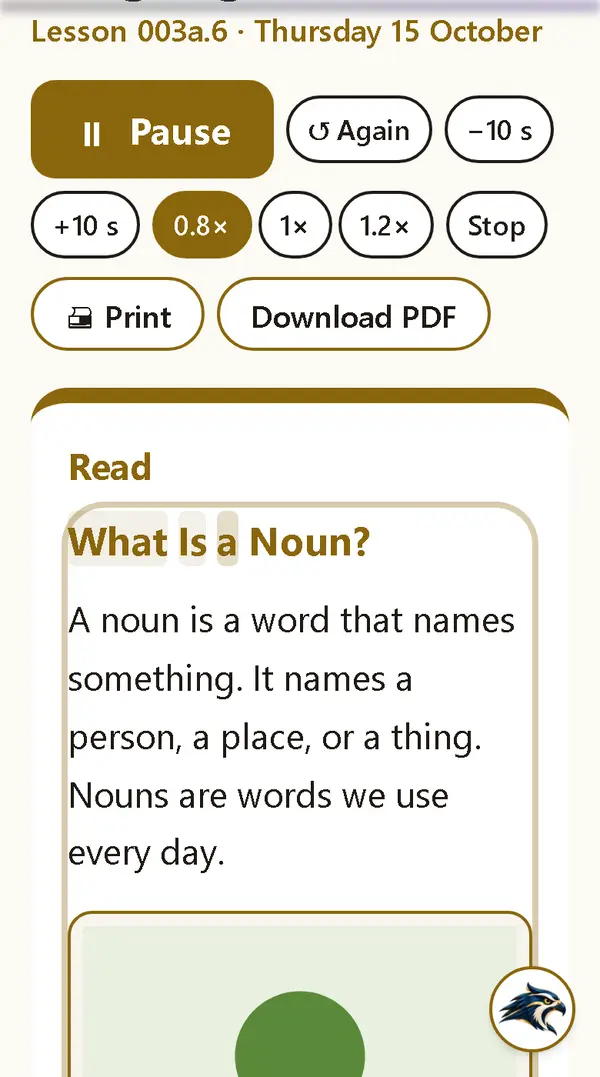
Every lesson's reading has a Read to me button, at every band, with one at the top of each part too. Where a reading has a recording, the narrator reads it; where it doesn't, the Hawk's voice does.
For Purple and Yellow, each word lights up as it is read, and a tap on a word plays just that word. Read to me uses no talking minutes and none of the Hawk's questions.
Printables
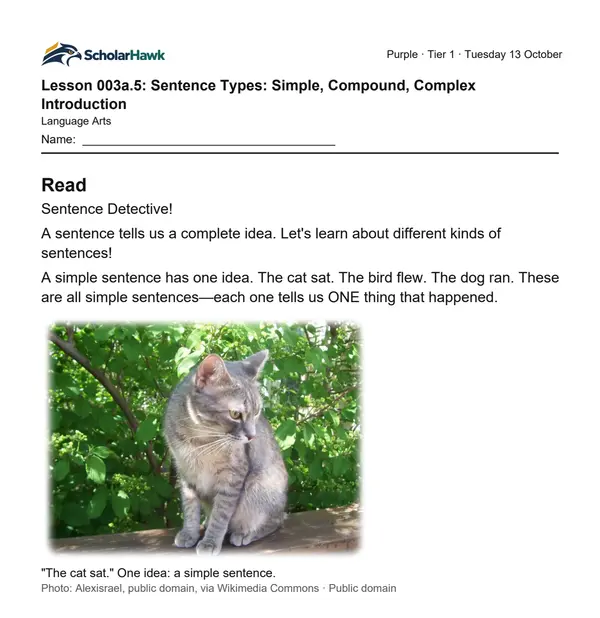
Every lesson prints: the Champion's sheets, flashcards (in the lesson sheets) and a one-page Daily 20 sheet. Champion sheets never show the answers.
Tens of thousands of printable pages.
The parent view
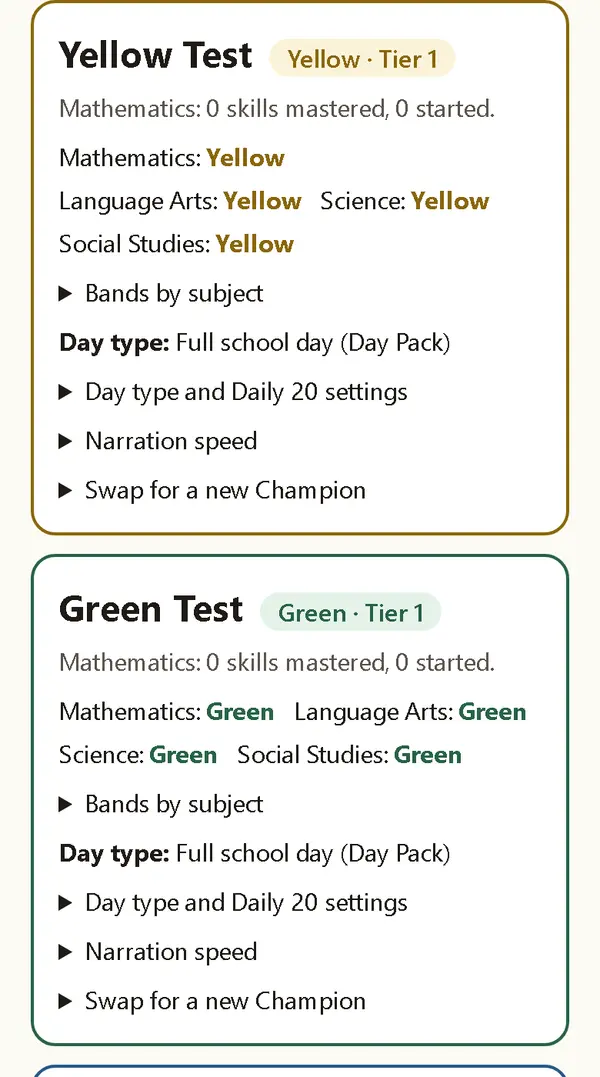
One page for the family: each Champion's band in each subject, each Daily 20 session under its date (the drill, the items right and missed, the story read), the week's personal bests, and every exchange with the Hawk.
The settings are there too: the Day Pack or Daily 20, the subject focus, the days, and the Hawk on or off.
Screen time: questions
Is screen time bad for children?
A screen is a tool, and like any tool it is often used badly. What matters is how it is used. The harm comes from hours lost to scrolling, to content that isn't safe for children, and to play that runs far longer than is healthy. Used with a purpose, for a set time, and balanced with time away from the screen, it can make learning faster and life better organized. ScholarHawk is built for that kind of use: short, focused learning, then off.
How much screen time does ScholarHawk use?
At home, Daily 20 is about 20 minutes a day; at Purple (ages 4–5), about 10 minutes, with a grown-up beside them. A full Day Pack day has more lessons, with the on-screen parts kept short and mixed with paper, reading and activity.
At the Academy, the on-screen blocks are short and spread through the day, between Coach-led lessons, hands-on work and active time.
Why use a screen at all?
For the practice that needs checking straight away: Mathematics, Science, spelling and the like.
On screen, answers are checked as soon as they are given, and questions missed come back on a later day until they stick.
Practice that used to take an evening of worksheets takes minutes, and the time saved goes to reading, building, moving and talking.
Can my child work on paper instead?
Yes. A Champion barely needs the screen at all.
Nearly everything in ScholarHawk prints: the lessons and readers, the Champion's sheets, flashcards (in the lesson sheets) and a one-page Daily 20 sheet.
A grown-up prints the day, the Champion works on paper, and the screen is used only for what it does best: checking answers on the spot.
With ScholarHawk and HummingRead, the main thing a family needs is a good printer. One with refillable ink tanks keeps the cost of printing every day low.
What we suggest is a mix: paper for reading, writing and working things out by hand, and the screen for short practice that is checked on the spot.
What can my child reach inside ScholarHawk?
Their lessons, their HummingRead reading, and lesson videos chosen by their Coach.
There are no ads, no feeds, no messages with other people and no tracking. The Hawk, ScholarHawk's guide, talks only about the lesson in front of the Champion, gives one hint at a time, and never gives the answer. Parents see every exchange with the Hawk and can turn it off at any time.
Is it built to keep children on the screen?
Daily 20 is built to finish: it ends with "Done for today". Practice stays open for a child who wants more.
Talking to the Hawk has a daily limit and a stretch break. There is nothing to scroll.
What can parents control?
From the family page: the days, the subject focus, the Hawk on or off, and talking to the Hawk on or off.
Parents see every exchange with the Hawk, and on Daily 20 days how many questions were right and missed and the story read.
How does a day at the Academy balance it?
The day is built around Coaches.
Lessons on screen sit between the Champion Shield, Conditioning, lunch and the Closing Circle, so no Champion spends long stretches in front of a screen.
Why teach with technology at all?
Technology is part of school, work and life. Using it with a purpose, for a set time, and then putting it away is a skill, and we train it like any other. Train the mind like an athlete: a plan, a set time, full effort, then rest.